
What’s Next for WeSelling: Chain-Agnostic Payments, Shielded Balances and Bilateral Escrow
The WeSelling team · · 8 min read
Crypto infrastructure is powerful. The problem is that using it still feels like infrastructure.
Which chain is my USDC on? Which network does the merchant support? Do I need to bridge first? Which wallet am I supposed to use?
For most merchants, none of these questions should exist. A business owner wants to sell. A customer wants to pay. Everything between those two actions should disappear into the product.
That is what we are building toward with WeSelling: familiar commerce on the surface, with crypto working quietly underneath.
See stablecoin payments in action
Here is a quick preview of a merchant receiving a stablecoin payment in WeSelling. The balance and transaction activity appear where the merchant already manages the rest of their business—without sending them to a separate crypto dashboard.
This is an early product preview. The broader routing, privacy and escrow capabilities described below are the direction we are building toward, not a claim that every part is already live.
Merchants shouldn’t need to become crypto experts
One principle sits behind this work: the advantages of crypto should be available without forcing merchants to understand crypto.
A merchant should be able to create a WeSelling account using something as familiar as an email address. Behind that onboarding flow, their business can be provisioned with the accounts and payment infrastructure it needs.
No seed-phrase ceremony. No lesson on rollups. No explanation of bridges before the first payment. No requirement to understand the difference between USDC on one network and USDC on another.
They should be able to open WeSelling, run their business, receive payments and see their balance. The complexity belongs underneath the product—not in front of the merchant.
One checkout, multiple possible routes
One of the next major pieces we are working toward is chain-agnostic stablecoin checkout.
The goal is straightforward: customers should be able to pay using the supported USDC they already have, while the merchant receives settlement without worrying about the chain it came from.
We plan to use NEAR Intents as part of the routing layer, with infrastructure such as CCTP handling compatible cross-chain USDC movement where appropriate.
Imagine a customer arrives at a WeSelling storefront and wants to buy something. They have USDC. That should be enough.
The merchant should not have to ask which network the customer uses. The customer should not have to leave checkout, find a bridge, move funds, return to the store and try again.
Instead, WeSelling should coordinate the route beneath the transaction:
- The customer chooses a supported stablecoin payment.
- The system identifies an available settlement route.
- Any required cross-chain movement happens in the background.
- Settlement reaches the merchant’s account.
- The merchant sees the payment alongside their normal business activity.
Underneath that simple flow may sit routing, cross-chain settlement, CCTP, smart accounts and Starknet. From the merchant’s perspective, only one thing happened: someone bought something and they got paid.
That is exactly how it should feel.
Shielded balances for real businesses
Putting business finance on public infrastructure creates another challenge: businesses do not necessarily want their entire financial position exposed to everyone.
Public blockchains are transparent by design. That transparency is valuable for verification, settlement and auditability, but complete financial visibility is not always appropriate for everyday commerce.
A merchant may not want every customer, supplier, competitor or observer to know exactly how much money the business holds. That is why shielded balances are another part of the direction we are exploring.
The goal is a better balance between verifiability and financial privacy. A merchant should be able to benefit from on-chain settlement without automatically turning their business balance into public information.
They open WeSelling. They see their balance. They can transact and settle payments. Meanwhile, commercially sensitive information does not have to be exposed to everyone who interacts with the business.
Privacy should not require merchants to abandon open financial infrastructure, and open infrastructure should not require businesses to abandon reasonable financial privacy.
Bilateral escrow for commerce between strangers
Payments solve one side of commerce. Trust solves the other.
Consider a customer discovering a legitimate but new merchant through WeSelling. The merchant has little transaction history and their reputation is still developing. The customer likes the product but is understandably cautious.
Telling the customer to “just trust them” is not good enough. Telling a new merchant to build a reputation first creates a circular problem: how do they establish a track record if nobody is willing to be their first customer?
Everybody deserves an opportunity to exchange value. Bilateral escrow can make that possible without requiring blind trust from either side.
Instead of immediately making the payment available to the merchant, a smart contract can hold the funds while the merchant fulfills the order. The release of payment becomes connected to clear, programmable conditions.
What an escrow-backed order could look like
Imagine a customer buying from a merchant they have never dealt with before.
1. The customer pays
The customer completes checkout using USDC. Instead of settling immediately to the merchant, the funds are locked in escrow.
2. The merchant fulfils the order
The merchant packages and dispatches the product. The order begins accumulating fulfilment evidence such as status changes, dispatch confirmation, logistics details and other relevant records.
3. Logistics confirms movement
The logistics provider confirms collection and, later, delivery. Those events become additional signals that the transaction is progressing correctly.
4. The customer confirms what arrived
Delivery alone does not always mean successful fulfilment. The customer can confirm that they received what they actually ordered—not merely that a package reached their address.
5. The agreement settles
Once the agreed conditions are satisfied, escrow releases the funds. The merchant gets paid, the customer gets what they purchased, and both parties gain another successful transaction in their history.
Value moves one way. Funds move the other. Trust does not have to exist beforehand.
Reputation should reduce friction, not block participation
Reputation systems are useful, but they should not become a wall around commerce.
A merchant with hundreds of successful transactions naturally presents a different risk profile from one who opened an account yesterday. That does not mean the new merchant should be excluded. It means the amount of protection around the transaction can change.
An established merchant may eventually need less friction. A new merchant may transact through escrow. Both can participate.
Instead of saying, “You are new, so nobody should trust you,” the system can say, “You are new, so we will use stronger guarantees while you establish trust.”
Every successful exchange then adds evidence. A merchant fulfils an order. A customer confirms receipt. Another transaction completes successfully, then another. Reputation stops being something a merchant claims and becomes something they have demonstrated.
Stablecoins should become infrastructure
We do not want crypto to feel like a separate section bolted onto an ERP. Merchants should not have to think, “Now I am using the crypto part.”
Stablecoins can become another settlement rail. Smart contracts can enforce agreements. Embedded accounts can make blockchain accounts feel like normal application accounts. Routing can happen invisibly. Privacy infrastructure can protect sensitive commercial information. Escrow can enable transactions where trust does not yet exist.
The merchant should simply experience a better commerce platform.
What we’re building toward
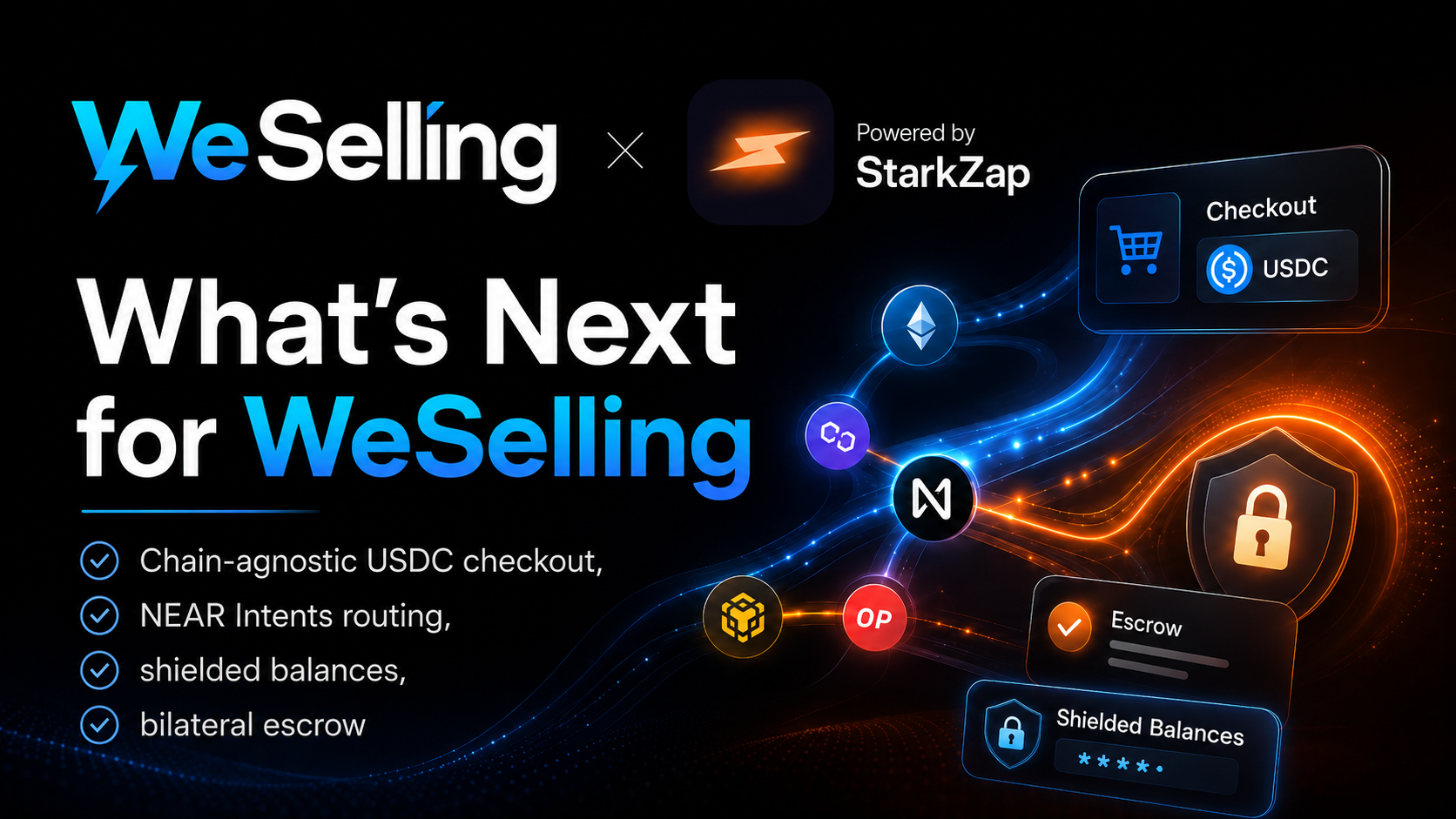
- Chain-agnostic USDC checkout: customers pay with supported USDC without making the merchant worry about its originating chain.
- NEAR Intents routing: routing infrastructure helps move value from the customer’s available assets toward the merchant’s settlement destination.
- CCTP-powered movement: where supported and appropriate, CCTP enables native USDC movement between networks without a manual bridging detour.
- Shielded balances: merchants benefit from on-chain settlement without advertising their entire financial position.
- Bilateral escrow: buyers and sellers can exchange value using programmable guarantees instead of blind trust.
- Embedded accounts: merchants can start with something as familiar as an email address while account and recovery infrastructure remains underneath the experience.
The merchant should never have to think about it
A business owner selling hair products does not care about cross-chain messaging. A restaurant owner does not want to study account abstraction. A fashion merchant does not want to understand bridging. A logistics company does not need a lecture on rollups before accepting payment.
They want commerce to work:
- Create your business.
- List what you sell.
- Share your storefront.
- Receive an order.
- Get paid.
Underneath that simplicity can live NEAR Intents, CCTP, Starknet, smart accounts, shielded balances, escrow contracts, cross-chain settlement and reputation.
Those are implementation details. The merchant does not need another piece of technology to manage. They need technology that manages itself.
Commerce on the surface. Crypto underneath.
That is what we are building toward with WeSelling.
A customer should be able to bring value from wherever it already lives. A merchant should be able to receive it without worrying about chains. Businesses should be able to maintain reasonable financial privacy. And two strangers should be able to exchange goods, services and money without requiring blind trust before the transaction begins.
Chain-agnostic payments. Shielded balances. Bilateral escrow. Programmable settlement.
All underneath a commerce experience that still feels as simple as buying and selling—because the future of crypto payments probably does not look like asking everyone to understand crypto. It looks like making the infrastructure good enough that they no longer have to.